MONOPOLY
- 4.1
- Rating
- 1.00M
- Installs
- $4.99
- Price

 Analysis by App-foxy
I have always thought of MONOPOLY as a game that is easy to recognize but surprisingly difficult to judge on a phone. The board, property buying, rent payments, and sudden reversals are familiar, yet a mobile version has to make all of that comfortable on a smaller screen without turning every turn into a slow chore. After spending time with MONOPOLY, my impression is that it succeeds best as a polished digital board game for people who already enjoy the original style of play and want a convenient way to bring it into a living room, a commute, or a quick evening session.
This is a board game from Marmalade Game Studio, based on Hasbro’s official MONOPOLY mobile release. It is aimed at Everyone, runs on Android devices using version 6.0 or later, and has been available since December 4, 2019. The current version is 1.15.13, so this is not a new experiment that still feels unfinished. It has also passed the early-adopter stage, with more than a million installs, an average rating of 4.1 from roughly 139,000 ratings, and about 20,000 written reviews.
The important question, though, is not whether the name is recognizable. It is whether this particular version gives me enough convenience and atmosphere to justify paying for it. The listed price is $4.99, while optional in-app purchases range from $0.99 to $59.99 per item. That makes the purchase decision different from a completely free board-game app: here, I am evaluating a paid starting point and then considering whether the optional spending changes the value.
You May Also Like

 Blood Strike: 2.5 Anniversary
Blood Strike’s Loadouts Turn Every Drop Into a Tactical Gamble
A close look at Blood Strike’s custom loadouts: how fast access to signature weapons reshapes its battle royale rhythm, rewards preparation, and narrows the gap between fights.

 Pandora - Music & Podcasts
Pandora’s Music Is Easy to Start, but Harder to Recover
Pandora’s strength is its low-effort path from a seed to a station. Its weak spot is how much confidence it asks you to place in connection, setup, and quiet recovery.

 8 Ball Pool
 Is Built on Rivalries, Rematches, and Routine
A close look at the rivalries, rematches, shared routines, and unanswered safety questions that turn a quick pool match into a persistent mobile community.

 Samsung Music
’s Quiet Strength Is Playing What You Already Own
Its reach comes less from spectacle than from dependable access to a personal library. That simplicity is both the app’s strongest retention engine and its ceiling.

 AccuWeather: Weather Radar
AccuWeather Review: A Quick, Clear Forecast for Everyday Decisions
For everyday plans, the best forecast is the one you can understand quickly. AccuWeather makes rain timing, radar, and local conditions easy to act on, with a few trade-offs.

 Hill Climb Racing
Why Hill Climb Racing Still Turns Crashes Into One More Run
A tiny car, a bumpy hill and one more upgrade: Hill Climb Racing keeps resurfacing because its simple chaos makes every near-miss feel personal.
More From Our News Desk



How the digital board feels in everyday play
The core appeal is immediate. I roll, move around the board, decide whether a property is worth buying, and watch the balance between cash, assets, and risk change from turn to turn. The digital format removes the small practical annoyances of a physical set: there is no money to count, no cards to shuffle, and no need to remember who owns which property. That convenience matters more than I expected when playing with people who know the tabletop game but do not want to prepare a full board on the dining table.
I find the automatic handling especially useful when several players are involved. In a physical game, a missed rent payment or a badly counted stack of notes can create an argument that has nothing to do with strategy. On a phone, the game keeps the transaction flow visible and makes the financial consequences easier to follow. That does not remove the emotional swings, but it does reduce the bookkeeping that can make a long board game feel tiring.
A realistic use case is a family waiting for dinner at a restaurant or spending a rainy afternoon at home. One person can bring out the phone, and the group can decide whether to play a few turns or settle in for a longer match. I would not describe it as a tiny five-minute distraction in the same way as a simple puzzle game. Even when the rules are familiar, property decisions and changing fortunes need attention. It works better when everyone has agreed to give the game a proper block of time.
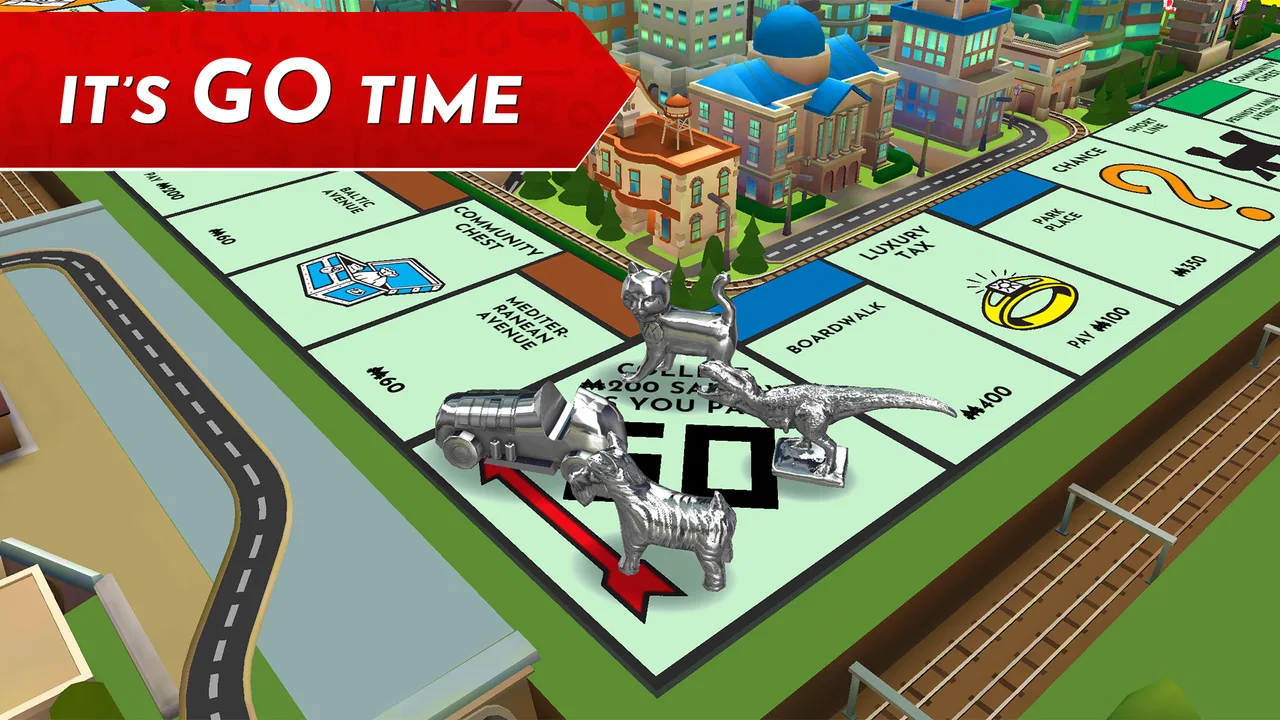
The official presentation also helps the experience feel like MONOPOLY rather than a generic property-trading clone. The recognizable board structure gives each purchase a clear emotional meaning: a cheap early property can become part of a plan, while an expensive square can look attractive and still damage a weak cash position. I enjoy that tension because the game constantly asks me to separate what I want to own from what I can safely afford.
What I pay for and what that means
The $4.99 price is the clearest part of the value equation. I am not starting with a free download and hoping the basic experience is enough before encountering payment pressure. I am buying access to a paid mobile game, then deciding whether any optional purchases are worthwhile. For someone who wants one familiar board game on a phone, that upfront cost can be easier to understand than a free title built around repeated prompts to spend.
At the same time, the presence of individual in-app purchases priced between $0.99 and $59.99 means I would not treat the initial payment as the whole financial story. The range is broad, and the upper end is substantial compared with the entry price. I would approach those extras carefully and set a spending limit before playing, particularly if the device is shared with children. The Everyone age rating describes the content suitability, but it does not turn optional purchases into a free part of the experience.
For me, the paid value depends on frequency. If I play with family or friends several times over the course of a month, the purchase feels easier to justify because the game replaces the work of setting up and managing a physical board. If I only open it once to relive the brand and then lose interest after one match, the price is harder to defend. That is not a flaw unique to this release; it is the basic risk of paying for a board game whose appeal depends heavily on whether the people around me enjoy its long, luck-driven sessions.
I also think the price should be judged against the alternatives. A physical MONOPOLY set creates a more social table experience and gives players something tangible to handle, but it takes space and requires everyone to be in the same place. Free digital board games may cost less to try, yet they often do not offer the same connection to this particular property. A paid official version sits between those choices: more convenient than cardboard, more expensive than a casual free app, and most valuable when I already know I like the underlying game.
Small decisions that make a big difference
One of the most useful habits I developed was treating cash as protection rather than as money that must immediately become property. The board encourages buying because an unowned space feels like a missed opportunity. In practice, spending too aggressively can leave me unable to absorb a bad landing. I prefer to keep enough available for rent and unexpected movement before chasing a complete color group.
Another practical tip is to watch the whole board rather than focusing only on the square directly in front of me. A property that looks inexpensive can become dangerous if another player is close to completing its group. Buying it may be less about making money immediately and more about denying someone else the chance to build a stronger position. That defensive choice is easy to overlook when the phone presents each turn as a simple roll-and-move action.
I also recommend slowing down during trades. The digital format makes transactions feel quick, which can tempt me to accept a deal just to keep the turn moving. Before agreeing, I consider whether the exchange gives another player a complete group, whether I will still have enough cash afterward, and whether the property helps my own long-term route. A trade that looks balanced by face value can be strategically poor if it creates a powerful opponent.
The best sessions are not necessarily the ones where I own the most property early. They are the ones where I keep several paths open. A modest collection with cash available can be more comfortable than an impressive portfolio that leaves no room for a costly landing. That is a useful lesson for newcomers because the game can feel random at first, while careful liquidity management gives the player something meaningful to control.
Where the experience can become frustrating
My main reservation is that the familiar rules bring familiar frustrations. Dice can overturn a thoughtful plan, and a player who makes sensible decisions can still suffer a run of poor landings. That unpredictability is part of MONOPOLY’s identity, but it means the game is not ideal for someone looking for a tightly skill-based strategy experience. If I want every result to feel earned through planning alone, I would choose a more deterministic board game instead.
Long sessions can also lose momentum. The early game is usually the most interesting because everyone is building a position and deciding what to pursue. Later, once one player has a clear advantage, the remaining turns may feel like a slow confirmation of an outcome that is already visible. On a physical board, conversation and shared handling can soften that feeling. On a phone, waiting through repeated movement and payments may feel more exposed.
The paid entry point creates another trade-off. I appreciate knowing that the game is not presented as a purely free download, but the optional purchase range makes me more cautious about recommending it to a child or to anyone who tends to buy impulsively. I would check the device’s purchase controls and make sure the person using it understands that the initial payment and later optional items are separate decisions.
The age rating of Everyone makes it suitable for a broad audience from a content perspective, but suitability is not the same as universal enjoyment. Younger players may need help understanding why keeping cash matters more than collecting every attractive property. Families should also be prepared for the competitive arguments that can arise when rent, trades, and luck turn one player into the target. The game is accessible, but the social mood still depends on the group.
Device compatibility is reasonably broad because Android 6.0 is the minimum operating system. Even so, I would not assume that an older phone will feel identical to a newer one. A board game does not demand the same kind of hardware as a modern action title, but screen size, responsiveness, and battery condition can affect comfort during a longer match. A small display may make the board harder to scan, especially when several properties and player positions need attention.
Who is likely to get the most from it
I think the strongest audience is a household or friend group that already likes MONOPOLY but wants less setup. The game is particularly convenient when the physical set is stored away, when pieces are easy to lose, or when players want the rules and money handling managed automatically. It also suits someone who enjoys board games but prefers keeping a small collection of digital titles rather than buying a large box for each favorite.
It can also work for a solo player who enjoys making decisions against computer-controlled opponents, provided that the main attraction is the classic property loop rather than constant novelty. I would not buy it expecting a deep strategy campaign or a completely different game every time. Its strength is the repeatability of the familiar system: each match creates a new mixture of purchases, trades, lucky movement, and financial risk.
People who should skip it are those who dislike luck deciding important outcomes, players who want fast rounds with almost no downtime, and anyone looking for a free experience with no optional spending attached. I would also hesitate to recommend it to someone who has never enjoyed the physical game. The mobile presentation makes the original format more convenient, but it does not transform the underlying pace or competitive personality.
Compared with a free casual board app, this release has the advantage of being tied to a recognizable official game and a clearly defined paid starting price. Compared with a physical set, it wins on portability and automatic bookkeeping but loses some of the social texture of moving pieces and exchanging money by hand. Compared with more strategic digital board games, it offers a friendlier entry point but accepts more randomness and a greater chance that a late-game lead will make the final stretch feel repetitive.
My decision after playing
I would recommend the purchase to someone who has a specific reason to want MONOPOLY on a phone: regular family play, easy travel access, or a preference for digital bookkeeping. The $4.99 entry price is understandable for that audience, especially when the alternative is carrying and setting up a physical board. I would be more reserved with optional purchases, because the listed range reaches from small additions to a much larger expense and does not automatically improve the basic board-game decisions that make the experience enjoyable.
My final view is positive but targeted. This is not the right choice because every mobile player needs another property game; it is the right choice when the official MONOPOLY format itself is the attraction. I like the convenience, the recognizable structure, and the way the app removes tedious counting without removing the tension of a bad landing. I also accept that luck, long finishes, and optional spending may bother some players.
My practical verdict: buy it if you already enjoy MONOPOLY and expect to return to it with other people; skip it if you want a short, fully free, highly skill-driven board game. For the right group, it turns a bulky tabletop favorite into something ready whenever the phone is available. For everyone else, the paid price is better saved for an experience whose pace and strategy match their tastes more closely.
FAQs for MONOPOLY
01What platforms is MONOPOLY available on?
MONOPOLY is available for both Android and iOS devices. You can download it from the Google Play Store for Android users and the Apple App Store for iOS users. The game is optimized for smartphones and tablets, providing a seamless gaming experience across different devices.
02Does MONOPOLY require an internet connection to play?
While MONOPOLY offers both offline and online modes, an internet connection is necessary for multiplayer games with friends or players worldwide. The offline mode allows you to play against AI opponents, which is perfect for when you don't have internet access.
03Are there in-app purchases in MONOPOLY?
Yes, MONOPOLY includes in-app purchases. While the base game provides a complete experience, players can buy additional content such as new boards, tokens, or themes. These purchases are optional and designed to enhance the gameplay for those who wish to customize their experience.
04How does multiplayer work in MONOPOLY?
The multiplayer mode in MONOPOLY allows you to play with friends or random players online. You can invite friends to join a private game or match with available players globally. The game features voice and text chat options, facilitating communication during gameplay.
05Is MONOPOLY suitable for children?
MONOPOLY is suitable for children, with a recommended age of 8 and up. The game is designed to be family-friendly, offering educational value in terms of strategic thinking and financial management. However, parental guidance is suggested due to in-app purchases.
Pros
- Classic board game experience on mobile.
- Smooth multiplayer mode for friends.
- Vibrant graphics enhance gameplay.
- Customizable rules for unique sessions.
- Offline mode available for solo play.
Cons
- In-app purchases can be pricey.
- Occasional connectivity issues.
- Long game times may deter casual play.
- Limited free content available.
- Requires a stable internet connection.

MONOPOLY
Gallery